New Thesaurus Terms for Searching APA PsycInfo (Winter 2025)

In March, APA added 36 new terms to its Thesaurus of Psychological Index Terms® to provide more effective searching on current topics, including child health; family therapy; and parenting. This Thesaurus update also includes 25 new cross-referenced terms, and 37 revised scope notes.

New terms from this winter update will initially be applied to current content only; following the Fall 2025 release, the majority of 2025’s new postable terms will be back-mapped to older records.
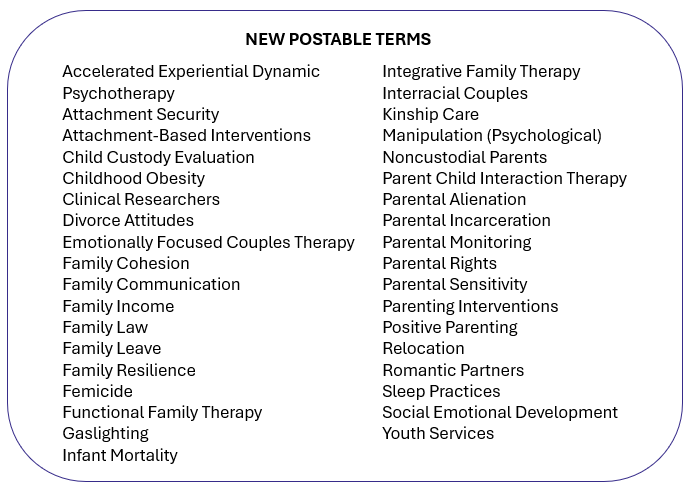
New Postable Terms include: attachment security, childhood obesity, family leave, and sleep practices.

Using the controlled vocabulary of the Thesaurus means a database search will quickly and accurately retrieve all publications related to a specific concept, regardless of the keywords the authors may have used.

The Thesaurus tool is found on all platforms as part of APA PsycInfo® and redirects synonyms to the preferred “Use” term to include in your search. Each Thesaurus record includes links to broader terms, narrower terms, and related terms, the year the term was introduced, an historical note if applicable, and a scope note providing definition and application.

You can see the full list of Thesaurus changes on our website 

Related Resource: 
YouTube playlist – Using the APA Thesaurus to Find Relevant Articles on a Topic 

Using APA PsycInfo Classification Codes on EBSCO

It’s Tutorial Thursday! In this series, we explore APA’s library of video tutorials available on the APA Publishing Training YouTube channel. Please feel free to link to or embed our videos in your library websites or LibGuides, course management systems, or other locations where students, faculty, and researchers will find them.

Classification Codes are used in APA PsycInfo and other APA Databases to broadly categorize the primary subject matter or the main focus of an article, book chapter, or dissertation.

Adding Classification Codes to your query can help limit your search to a particular content theme. They’re a great tool for quickly limiting a large list of search results to better fit your research question, or when a search term can mean different things in different contexts, or different subfields of psychology.

Related Resource

APA Website: List of Classification Codes 

APA PsycNet: How to Export Citations to Citation Management Tools

It’s Tutorial Thursday! In this series, we explore APA’s library of video tutorials available on the APA Publishing Training YouTube channel. Please feel free to link to or embed our videos in your library websites or LibGuides, course management systems, or other locations where students, faculty, and researchers will find them.

In this video you’ll learn How to Export Items from APA PsycNet into Citation Management Tools like RefWorks, EndNote, Mendeley, or Zotero. We’ll start by briefly mentioning the benefits of using a citation management tool. Then, we’ll demonstrate how to export results into EndNote Web and RefWorks. We’ll wrap up the video by showing you how to save results to an .RIS file that can be used with EndNote Desktop, Mendeley, Zotero, and Academic Writer.

By the end of this video you will be able to:

  • Explain the benefits of using a citation management tool
  • Export citations from APA PsycInfo into EndNote Web and RefWorks
  • Generate an .RIS file that can be downloaded and imported into tools such as EndNote Desktop, Mendeley, Zotero, and Academic Writer.

Related Resource
Learning Commons: I need help exporting references from APA PsycNet

Video demo: Academic Writer’s Reference Center

Peer-Reviewed Empirical Articles


It’s Tutorial Thursday! In this series, we explore APA’s library of video tutorials available on the APA Publishing Training YouTube channel. Please feel free to link to or embed our videos in your library websites or LibGuides, course management systems, or other locations where students, faculty, and researchers will find them.

The first video, Finding High Quality Original Research in APA PsycInfo, is an introduction for all platforms that explains what an empirical study is and what it means for a study to be published in a peer-reviewed journal.

The second video demonstrates how to quickly and easily find peer-reviewed empirical articles using the filters in APA PsycInfo. 

Select the video for the platform or website that hosts APA PsycInfo at your institution. 

By the end of this 2-part tutorial you will be able to:

  • Explain what it means for an article to be considered an empirical study.
  • Describe the process that an article goes through to be published in a peer-reviewed journal.
  • Use the filters in APA PsycInfo to access empirical studies from peer-reviewed journals.
  • Determine if an article found in APA PsycInfo is an empirical study from a peer-reviewed journal.

Using the APA Thesaurus to Find Relevant Articles on a Topic

 

It’s Tutorial Thursday! In this series, we explore APA’s library of video tutorials available on the APA Publishing Training YouTube channel. Please feel free to link to or embed our videos in your library websites or LibGuides, course management systems, or other locations where students, faculty, and researchers will find them.

APA thesaurus terms, also called index terms, are controlled vocabulary used in database records to make searching easier and more successful. By standardizing the words or phrases used to represent concepts, you don’t need to try and figure out all the ways different authors could refer to the same concept.

The first video, Building a Search with the APA Thesaurus and Index Terms, is an introduction for all platforms that shows what the thesaurus is, why it is a valuable search tool, and what to do if you can’t find a thesaurus term to fit your research concept. 

The second video demonstrates how to use thesaurus terms in an APA PsycInfo search to find relevant articles on a topic, and how to revise a search to include additional thesaurus terms. 

Select the video for the platform or website that hosts APA PsycInfo at your institution. 

Learn more about the APA Thesaurus on our website