APA Librarian Conference Travel Award: Reflections on ALISE 2016

The most recent recipient of the APA Librarian Conference Travel Award, Karen N. Reed from the Middle Tennessee State University, used the award to defray the cost of attendance at the Association for Library and Information Science Education (ALISE) conference in January. Alison Cody in APA’s Databases & Electronic Resources Customer Relations group recently talked with her to get her impressions of the conference. The following transcript of their conversation has been lightly edited for clarity and context.

Alison: What are your overall impressions of the ALISE conference?

Karen: I had a wonderful time at ALISE! It was very well-organized, and there were a nice range of session topics to choose from.

Alison: While you were there this year, you presented a paper to a special interest group in your research area. How did that go?

Karen: Yes, I presented a paper to the School Library Media SIG, which is an interest group for educators of K-12 school librarians. I was nervous going in, but was very pleased when it was over and I was able to receive audience feedback. People were very supportive but also asked questions that helped me think of an area for future research. You know, when you’re wrapped up in a research project, the subject matter is so clear to you – getting feedback from others can help you see things in a different light, or question where you were going. All of these ideas from others can only strengthen your work.

Alison: That must have been extremely valuable. Was the feedback useful for the current paper as well?

Karen: Yes, the feedback from my audience regarding my paper was so helpful; I’ve taken that feedback into account in tweaking my paper before I submit it for publication. Also, I was amazed at the individuals who attended my presentation: these were well-known people in my field. In fact, several of the people who spoke to me and gave me feedback were researchers that I had quoted in my paper! In speaking to them, I really had to stifle my fangirl urge to gush and instead try to act professional in talking research. But part of me was thinking “Oh my gosh, I can’t believe I’m talking to so-and-so!”

Alison: What a great experience! What else did you pick up while you were there?

Karen: It was extremely helpful to me to listen to the different presentations and compare their research methodologies. I saw a nice range of ideas, and seeing their practical application to a research scenario gave me much to think about. I am currently writing my dissertation proposal, so it was perfect timing for me to attend this conference and soak in the research designs that have worked for other people.

Alison: It sounds like this was a great conference for you. Who would you recommend ALISE to, and why?

Karen: ALISE is structured towards university library science educators, which is a smaller and more specialized group than the prior librarian conferences I’ve attended such as ACRL. This is a more close-knit group of regulars who seem to know each other and work well together across different institutions. If this is a group that you are interested in meeting with and networking, then I highly encourage this conference.

Alison: I agree! And I’m glad to hear that it was a useful conference for you.

Karen: I am just very grateful to the APA for funding this opportunity. The conference went by very quickly, but I will remember it as a career highlight.

Alison: I’m so glad to hear that! Thank you for taking the time to talk with me today.

Now through March 31, 2016, the APA Librarian Conference Travel Award is accepting applications for conferences taking place from May to August 2017. Please see the website for more details on eligibility, deadlines, and application materials.

APA Style CENTRAL – Technical Requirements

Today we’d like to highlight one of our APA Style CENTRAL handouts, “APA Style CENTRAL® Technical Requirements” (PDF, 497K). Please feel free to link to this handout where students, faculty, and researchers will find it!

APA Style CENTRAL is designed to work with a wide range of technical settings within a Windows or Mac environment. The APA Style CENTRAL Technical Requirements handout will help you answer your users’ most common institutional access and technical questions. This document also provides helpful tips for the end user’s individual system configuration to ensure reliable access to APA Style CENTRAL and the best possible user experience.

Details include:

  • Operating systems, recommended browsers, and mobile access;
  • Proxy configuration, including appropriate browsers for proxy access; and
  • Contact information for APA Style CENTRAL Support plus the list of the technical information we will need from the end user to help resolve the problem.

Along with the Creating APA Style CENTRAL® Accounts handout (PDF, 296K, also recently highlighted on this blog), the APA Style CENTRAL Technical Requirements document will be a valuable resource in helping you to resolve any access difficulties for your end users as quickly as possible.

Want to learn more? You’ll find this handout on our APA Style CENTRAL® Handouts and Guides page, where we will continue to add handouts and documentation for users and administrators as they become available.

Do you have a “how-to” question about APA Style CENTRAL or some aspect of it you’d like to know more about? Please let us know!

Webinar Alert: PsycINFO Sessions for Students & Faculty – February 22-24, 2017

Our next series of PsycINFO® webinars for students and faculty will run on February 22, February 23, and February 24 from 11 – 11:30 a.m. EST (UTC -5). The sessions may be attended separately, but we encourage those who are interested to take all three, so we offer them on consecutive days:

We will provide information relevant to all search platforms including APA PsycNET, EBSCOhost, Ovid, and ProQuest. The platform demonstrated will be based on the needs of the attendees of each session. For more information on this series, including full descriptions, please visit our database webinar training web page.

These webinars are an ideal way for students to get a refresher on PsycINFO if they have had a previous training session. Please help us spread the word to interested students and faculty!

From the Deck of . . . The ALA Midwinter 2017 Lunch & Learn

Welcome to “From the Deck of . . .” an irregular series in which we highlight search demos and other information from the slide decks we create for our live training sessions. You can view and download these materials from our SlideShare account.

We recently presented our Lunch & Learn training session at the American Library Association (ALA) Midwinter Meeting & Exhibition. During the session, we reviewed PsycTESTS®, an extensive collection of psychological tests, measures, scales, surveys, and other instruments. Over 42,000 tests are represented in the database, and a full or partial version of the measure is available for about 50% of them.

PsycTESTS is a wonderful resource for students learning to conduct measures, or researchers developing their own tests. In addition, many of the tests included can be used for non-commercial research and educational purposes, which includes general clinical use. (For more information, see our post How Permissions Work in PsycTESTS.)

During our session at ALA Midwinter, we reviewed the record structure of PsycTESTS, which is very different from a database like PsycINFO®. In PsycINFO, one article is represented by one record, which contains information about the article, taken from the article itself. In PsycTESTS, a test can be represented by multiple records, which contain information about the test, taken from a source document. A source document is typically a journal article, book chapter, technical report, or dissertation.

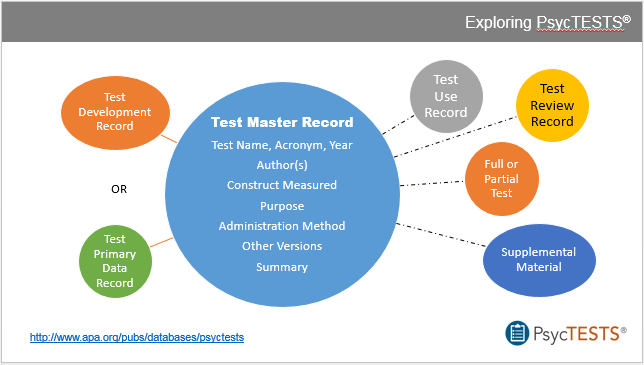
Visual representation of PsycTESTS record structure at http://www.apa.org/pubs/databases/psyctests

A visual representation of the record structure for PsycTESTS.


Every test in PsycTESTS is represented by a Test Master Record, which displays basic information about the test. You’ll also see either a Test Development Record or a Test Primary Data Record, which provide additional information about the test.

  • The Test Master Record provides basic information about the instrument and links to other records, which contain information from source documents, such as a journal article or book chapter:
    • Test Development Record: provides information describing the development of the measure
    • A Primary Data Record is provided for commercial tests, or tests with no source document (for example, a historical test)

A small number of tests will have an additional record or records:

    • Test Use Record: provides information describing a new use of the measure (for example, an article that reports on using a test developed for adults with children)
    • Test Review Record: provides information about an evaluation of the measure

The way these records are connected, and how they interact with one another, varies widely depending on how you access PsycTESTS: via APA PsycNET®, EBSCOhost, Ovid, or ProQuest. To see what a PsycTESTS record looks like on your platform, take a look at the slides from our Lunch & Learn. You’ll also find some sample search scenarios for PsycTESTS.

The presentation also included an overview of incorporating APA Style CENTRAL® into your teaching, and a look at some new and forthcoming publications.

Related Resources:

A “Getting Started with PsycTESTS” guide is available for each of the major vendor platforms. This handout demonstrates the various fields and features in PsycTESTS. To download or link to this resource, visit our Search Guides page.

Tutorial Thursday: Writing With APA Style CENTRAL

It’s Tutorial Thursday! In this series, we explore APA’s extensive library of video tutorials. In addition to our APA Databases and Training Videos available on YouTube, we now have an emerging library of training videos on our new APA Style CENTRAL® YouTube Channel. Recordings of webinars, like the one linked below, and other training videos are added as they become available.

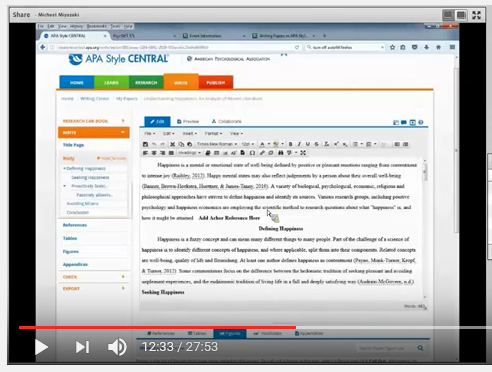
For today’s edition of Tutorial Thursday, we’d like to share a recording of one of our APA Style CENTRAL webinars: Writing With APA Style CENTRAL.
Screenshot from the recording of the Writing With APA Style CENTRAL webinar

Covering the unique features and tools that make APA Style CENTRAL a powerful resource for writing in APA Style®, this webinar is designed for undergrad students who are new to APA Style, as well as graduate students and faculty members looking for a refresher. This session provides a brief overview of how to:

  • Seamlessly include all of the required elements of APA Style when writing your paper;
  • Create and manage your APA Style references with ease and accuracy, including RIS-import from your current reference manager;
  • Easily create a properly formatted reference list and in-text citations; and
  • Use the collaboration functionality for simple annotated review or multiple authorship.

Please feel free to link this video or any of our APA Style CENTRAL playlists in your library websites, LibGuides, course management systems, or other locations where students, faculty, and researchers will find them.

With the winter holidays behind us, we will resume our live sessions of this webinar again in late January. When the schedule is ready, we’ll announce it here on the blog and post it on our APA Style CENTRAL training web page.