
PsycARTICLES Expert Tip: What Journals Are Included?

PsycARTICLES®, our full-text database of articles published by APA and affiliated journals, is a rich resource of peer-reviewed articles dating back more than a century. Researchers can find the latest scholarship from across psychology and the behavioral sciences, and can also look back at the history and development of psychology.

But what’s in PsycARTICLES? As of today, the full-text of more than 100 journals is available, back to Volume 1, Issue 1 in most cases. One way to peruse the list of titles is to simply use the Browse menu on APA PsycNET, where you can choose to see the list alphabetically by title, or arranged by topic. (EBSCOhost, Ovid , and ProQuest offer a similar feature.)
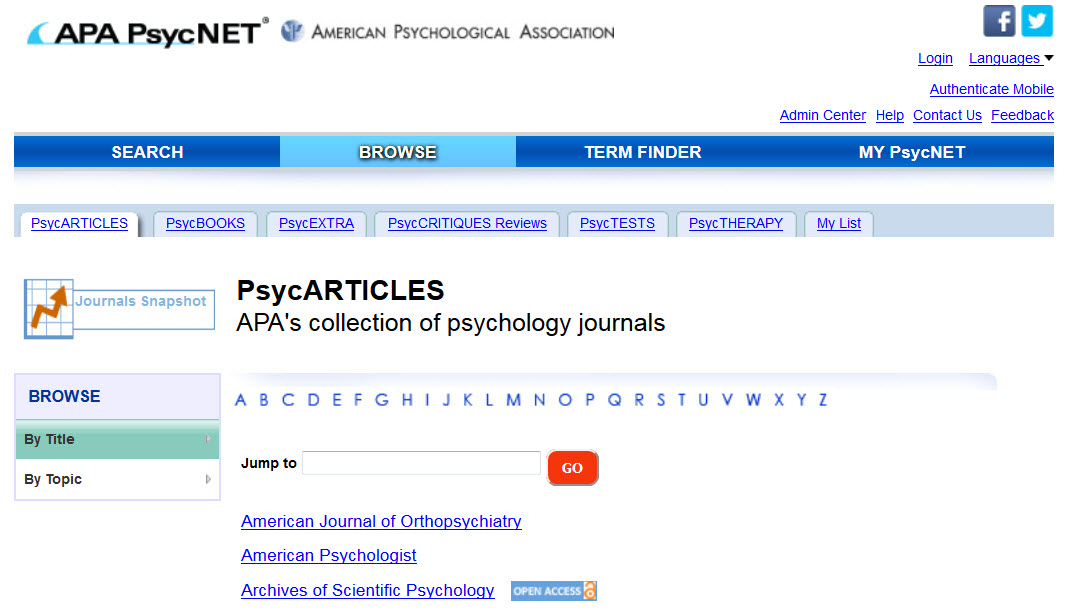
Screenshot showing the Browse page for PsycARTICLES on APA PsycNET

Browsing PsycARTICLES on APA PsycNET.

The advantage of using the Browse function built into PsycARTICLES is that you can easily access individual issues of each journal, and from there the full-text of individual articles. However, we also have the full list on our website, where you can easily see the years of publication available, as well as the volumes. This can be helpful if you simply want to quickly check whether or not a particular publication is included.

Screenshot of PsycARTICLES coverage list from the APA website.

The full list of journals in PsycARTICLES is available on the APA website.


We also provide access to a document that details any name changes for journals covered in PsycARTICLES.

This information, and more, can be found on the PsycARTICLES Coverage Information webpage. You can find coverage information for our other databases in the Search Help and Training Center.
PsycINFO Expert Tip: Classification Codes

Have you ever noticed the Classification Codes in PsycINFO® and wondered what they’re for?

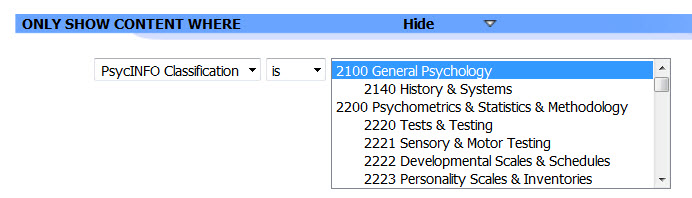
Screenshot of the Classification Codes limiter on APA PsycNET.

The Classification Codes limiter on APA PsycNET.

Our indexers tag and categorize each item in PsycINFO so searchers can more easily locate exactly what they need. Classification Codes categorize an item, such as a journal article, by its main theme. Each item receives one, sometimes two, Classification Codes. Continue reading

From the Deck of . . . The ALA Annual 2016 Lunch & Learn

Welcome to “From the Deck of . . .” an irregular series in which we highlight search demos and other information from the slide decks we create for our live training sessions. You can view and download these materials from our SlideShare account.

We recently presented our Lunch & Learn training session at the American Library Association Annual Conference & Exhibition. One of the items we covered in this session was a review of working with cited references in PsycINFO® on all of the major vendor platforms: APA PsycNET®, EBSCOhost, Ovid, and ProQuest.

Being able to successfully navigate cited references data allows you to identify where a particular piece of research fits into the larger research continuum. You can see what led to that research, and how it influenced the research that followed. It’s also a great way to help a student who’s brainstorming dissertation topics, or a researcher looking for a new area to explore. Continue reading

APA Librarian Conference Travel Award: Reflections on ALA Annual 2016

The most recent recipient of the APA Librarian Conference Travel Award, Callie Wiygul Branstiter from the University of Southern California – Los Angeles, used the award to defray the cost of attendance at the American Library Association Annual Conference & Exhibition in June. Alison Cody, a Training Specialist in APA’s Databases & Electronic Resources Customer Relations group, recently talked with her to get her impressions of the conference. The following transcript of our conversation has been lightly edited for clarity and context.
Continue reading

Tutorial Thursday & Translated Topic Guides

It’s Tutorial Thursday! In this series, we explore APA’s extensive library of video tutorials, available on YouTube. Please feel free to link or embed videos or playlists in library websites or LibGuides, course management systems, or other locations where students, faculty, and researchers will find them.

Are you familiar with our Topic Guides?

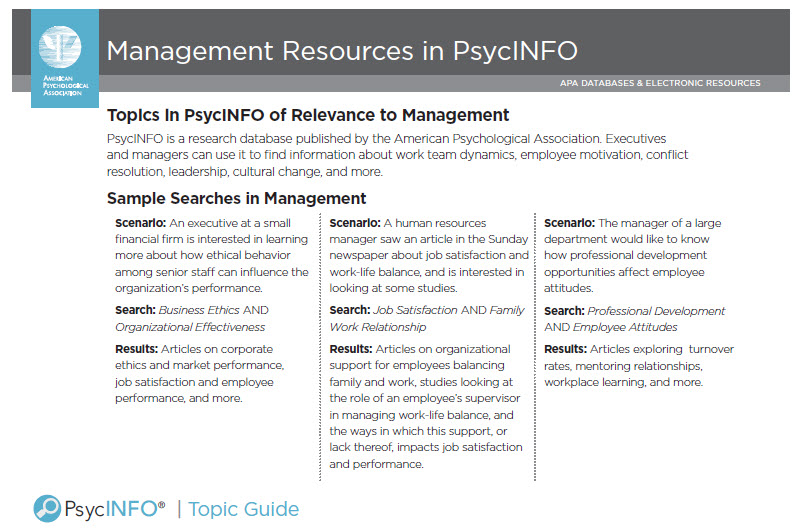
Sample searches from the Management Topic Guide.

Sample searches from the Management Topic Guide.

These brief interdisciplinary handouts are designed to demonstrate how PsycINFO can be used to search for resources in a variety of topic areas. They contain three sample search scenarios, and a list of selected Index Terms.

We’ve created video tutorials based on the Feminism, Management, and Nursing Topic Guides. The videos walk through each of the three sample searches from the guide, demonstrating how to create the searches using the Thesaurus. For each tutorial, you’ll find a version for the APA PsycNET, EBSCOhost, Ovid, and ProQuest platforms. We’ve gathered them all together into a playlist on our YouTube channel.

A screenshot from the APA PsycNET version of the video tutorial for the Management Topic Guide.

A screenshot from the APA PsycNET version of the video tutorial for the Management Topic Guide.

In addition to creating these tutorials, we recently translated all 20 Topic Guides into 8 languages: Chinese, French, German, Italian, Portuguese, Russian, Spanish and Turkish..

The Spanish version of the Grief & Trauma Topic Guide.

The Spanish version of the Grief & Trauma Topic Guide.

You’ll find the translations linked at the bottom of the Topic Guides webpage.

Related Resources:

Topic Guides pair well with our PsycINFO Quick Reference Guides, which walk the user through searching some of the fundamental fields in PsycINFO, such as Index Term/Subject Heading, Title, Author Name, and more.

Quick Reference Guide for PsycINFO on APA PsycNET
Quick Reference Guide for PsycINFO on EBSCOhost
Quick Reference Guide for PsycINFO on ProQuest
Quick Reference Guide for PsycINFO on Ovid

Please note that print copies of Quick Reference Guides are available to libraries upon request, free of charge. Send a message to psycinfo@apa.org and let us know which guide you’d like, how many, and where to send them.