APA PsycTests – Reliability, Validity & Factor Analysis

If you’re planning to cite or reuse a test you find in APA PsycTests®, you’ll want to check the reliability, validity, and factor analysis to make sure it suits your research.

Reliability is the ability of a test to measure an attribute consistently. If a group of people takes a personality test and many of them get different results from one day to the next, the test has low reliability.

Validity is the degree to which a test reflects what it is supposed to measure. If a test that is supposed to measure general intelligence actually measures the ability to recall classic literature, the test has low validity.

Factor Analysis is a mathematical procedure that reduces a set of interrelations among variables to a smaller set of variables. For example, a sociology survey might start with six factors of wealth (income, education, occupation, home value, parks in neighborhood, and crime in neighborhood) and, using statistical correlations, reduce them to just two factors: individual socioeconomic status and neighborhood socioeconomic status.

These three psychometric fields can be found in the Test Development Record. The Test Development Record provides details from the original article that discusses the development of the test. This information should help you determine if this test will fit your needs. (Note that if the authors do not report this information in the original article, then it will not be provided in the APA PsycTests record.)

Some tests will also have Test Use and Test Review records. Each APA PsycTests record pulls information from a different research article, so the reliability, validity, and factor analysis can be different from record to record, even if they describe the same test. View a sample APA PsycTests record to see where these fields are located within the record and the data they might contain.

If you need to find the full text of the original article, look in the Reported In or Source field. If you’re having trouble finding full-text for the original article, ask your librarian.

When choosing a test for reuse, don’t forget to check permissions!

Webinar Alert: PsycINFO Sessions for Students & Faculty – April 5-7, 2017

Our next series of PsycINFO® webinars for students and faculty will run on April 5, April 6, and April 7 from 11 – 11:30 a.m. EDT (UTC−04:00). The sessions may be attended separately, but we encourage those who are interested to take all three, so we offer them on consecutive days:

We will provide information relevant to all search platforms including APA PsycNET, EBSCOhost, Ovid, and ProQuest. The platform demonstrated will be based on the needs of the attendees of each session. For more information on this series, including full descriptions, please visit our database webinar training web page.

These webinars are an ideal way for students to get a refresher on PsycINFO if they have had a previous training session. Please help us spread the word to interested students and faculty!

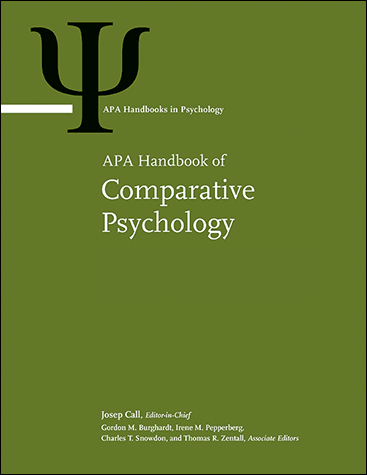
New Handbook: The APA Handbook of Comparative Psychology

The APA Handbooks in Psychology series was launched in 2011 to provide comprehensive overviews and in-depth study of specific subfields within psychology. All of the Handbooks are included in the PsycBOOKS® database, and titles are also available individually.

The series currently contains 23 authoritative titles, including the 2014 CHOICE Outstanding Academic Title, APA Handbook of Sexuality and Psychology.

The most recent addition to the series, the APA Handbook of Comparative Psychology, was published in September 2016. This two-volume set highlights community psychology’s emphasis on the synergistic relationship between research and action, and offers an international outlook, including chapters integrating perspectives from across cultures and contexts around the world. For more information, including a full table of contents, please visit the APA website.

PsycBOOKS users on APA PsycNET® (including subscribers to APA PsycNET Gold, Gold Plus, and Platinum), EBSCOhost, Ovid and ProQuest can access the entire series by browsing PsycBOOKS or by performing a title search for a particular handbook.

Institutions also have the option of purchasing handbooks individually. Print only, Electronic only, or Electronic + Print options are available through APA, with electronic access provided via the APA PsycNET® platform. For more information on pricing and availability, please see the APA website or contact us at quotes@apa.org.

Webinar Alert: PsycINFO Sessions for Students & Faculty – February 22-24, 2017

Our next series of PsycINFO® webinars for students and faculty will run on February 22, February 23, and February 24 from 11 – 11:30 a.m. EST (UTC -5). The sessions may be attended separately, but we encourage those who are interested to take all three, so we offer them on consecutive days:

We will provide information relevant to all search platforms including APA PsycNET, EBSCOhost, Ovid, and ProQuest. The platform demonstrated will be based on the needs of the attendees of each session. For more information on this series, including full descriptions, please visit our database webinar training web page.

These webinars are an ideal way for students to get a refresher on PsycINFO if they have had a previous training session. Please help us spread the word to interested students and faculty!

From the Deck of . . . The ALA Midwinter 2017 Lunch & Learn

Welcome to “From the Deck of . . .” an irregular series in which we highlight search demos and other information from the slide decks we create for our live training sessions. You can view and download these materials from our SlideShare account.

We recently presented our Lunch & Learn training session at the American Library Association (ALA) Midwinter Meeting & Exhibition. During the session, we reviewed PsycTESTS®, an extensive collection of psychological tests, measures, scales, surveys, and other instruments. Over 42,000 tests are represented in the database, and a full or partial version of the measure is available for about 50% of them.

PsycTESTS is a wonderful resource for students learning to conduct measures, or researchers developing their own tests. In addition, many of the tests included can be used for non-commercial research and educational purposes, which includes general clinical use. (For more information, see our post How Permissions Work in PsycTESTS.)

During our session at ALA Midwinter, we reviewed the record structure of PsycTESTS, which is very different from a database like PsycINFO®. In PsycINFO, one article is represented by one record, which contains information about the article, taken from the article itself. In PsycTESTS, a test can be represented by multiple records, which contain information about the test, taken from a source document. A source document is typically a journal article, book chapter, technical report, or dissertation.

Visual representation of PsycTESTS record structure at http://www.apa.org/pubs/databases/psyctests

A visual representation of the record structure for PsycTESTS.


Every test in PsycTESTS is represented by a Test Master Record, which displays basic information about the test. You’ll also see either a Test Development Record or a Test Primary Data Record, which provide additional information about the test.

  • The Test Master Record provides basic information about the instrument and links to other records, which contain information from source documents, such as a journal article or book chapter:
    • Test Development Record: provides information describing the development of the measure
    • A Primary Data Record is provided for commercial tests, or tests with no source document (for example, a historical test)

A small number of tests will have an additional record or records:

    • Test Use Record: provides information describing a new use of the measure (for example, an article that reports on using a test developed for adults with children)
    • Test Review Record: provides information about an evaluation of the measure

The way these records are connected, and how they interact with one another, varies widely depending on how you access PsycTESTS: via APA PsycNET®, EBSCOhost, Ovid, or ProQuest. To see what a PsycTESTS record looks like on your platform, take a look at the slides from our Lunch & Learn. You’ll also find some sample search scenarios for PsycTESTS.

The presentation also included an overview of incorporating APA Style CENTRAL® into your teaching, and a look at some new and forthcoming publications.

Related Resources:

A “Getting Started with PsycTESTS” guide is available for each of the major vendor platforms. This handout demonstrates the various fields and features in PsycTESTS. To download or link to this resource, visit our Search Guides page.